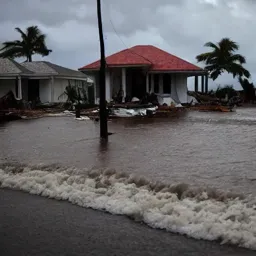
Hurricane Irma hit the Caribbean and parts of Florida last week, killing at least 61 people and leaving many thousands without homes. The storm was extremely strong, with winds up to 185 mph, and it destroyed most buildings on Barbuda and damaged many houses on St. Martin, Cuba and the Florida Keys. Leaders from Europe and the United States visited the affected areas and promised to help rebuild. In the text, two people talk about how they feel after the disaster—one is angry and the other is still in shock. They also argue that global warming may make such powerful storms happen more often, but they agree that helping the victims must come first.
- Irma
- Definition: The name of the hurricane that devastated the Caribbean and parts of Florida in the described week.
- Example: Hurricane Irma devastated much of the Caribbean and parts of Florida last week.
- hurricane
- Definition: A powerful tropical storm with extremely high winds that struck the United States twice within two weeks.
- Example: The storm was the second powerful hurricane to hit the United States in just two weeks.
- global warming
- Definition: The increase in Earth's average temperature that the speakers blame for making storms more intense and frequent.
- Example: Joshua argues that global warming will only make these kinds of storms more intense and more frequent.
- damage
- Definition: The destruction and severe harm to buildings and homes caused by the storm.
- Example: On Barbuda, an estimated 95 percent of buildings were damaged and destroyed.
- grief
- Definition: The emotional stages (shock, denial, anger, etc.) experienced by people after the traumatic hurricane events.
- Example: Joshua says he is already at the anger stage of grief following the hurricanes.
- How many people were reported killed by Hurricane Irma according to the passage?
- 45
- 61
- 78
- 102
- Which Caribbean island had approximately 95 percent of its buildings damaged or destroyed?
- St. Martin
- Barbuda
- Cuba
- Haiti
- Which European leader is mentioned as having visited the Caribbean to promise reconstruction?
- German Chancellor Angela Merkel
- French President Emmanuel Macron
- Italian Prime Minister Giuseppe Conte
- Spanish King Felipe VI
- According to Joshua, what are the stages of grief he mentions in order?
- denial, anger, shock, sadness
- shock, denial, something else, anger
- anger, denial, shock, acceptance
- shock, sadness, denial, anger
- What does Emily suggest should be the immediate focus after the storm?
- debating climate change
- rebuilding homes
- holding political protests
- conducting scientific research
- Do you agree with Joshua that global warming is the main reason for hurricanes like Irma and Harvey? Why or why not?
- Have you ever experienced a natural disaster? Share how you felt after it.
- What might have happened if the governments had prepared better before the storm hit?
- Why do you think the Caribbean islands suffered more damage than Florida?
- Should leaders focus first on rebuilding homes or first on discussing climate change? Explain your view.
- Is it fair to blame global warming for every extreme weather event? Why or why not?
- If you could write a news headline about Hurricane Irma, what would it be?
- Imagine you could interview the Pope about climate change. What three questions would you ask him?
- Rewrite Joshua’s last sentence so it sounds more hopeful instead of angry.
- Which stage of grief (shock, denial, anger, etc.) do you think most people are in after the hurricane, and how can they move to the next stage?

Hurricane Irma leaves dozens dead in the U.S. and Caribbean
Hurricane Irma devastated much of the Caribbean and parts of Florida last week and weekend, killing at least 61 people total and leaving thousands homeless. The storm was the second powerful hurricane to hit the United States in just two weeks, following Hurricane Harvey in Texas and Louisiana.
The damage was particularly severe in the Caribbean, where the storm brought torrential rains and winds as high as 185 miles per hour. On the small island of Barbuda, an estimated 95 percent of buildings were damaged and destroyed, and on St. Martin, around six in 10 homes are now uninhabitable. In Cuba, 10 people died and parts of Havana’s historic district were flooded with chest-high water.
European leaders including French president Emmanuel Macron, King Willem-Alexander of the Netherlands, and British Foreign Minister Boris Johnson visited the Caribbean earlier this week, promising to rebuild. U.S. President Donald Trump is scheduled to visit Florida tomorrow. An estimated 25 percent of homes in the Florida Keys at the southern tip of the state were destroyed during the storm.
Joshua: They say that there are different stages of grief following a traumatic event. I don’t remember exactly what they are right now, but I think it’s shock, denial, something else, and then anger … Emily, I am already at the anger stage.
Emily: I’m still in the shock stage… and very sad.
Joshua: I’m sad too, but I’m very upset. What I mean is: When will people acknowledge the role that global warming played in these storms, Emily?! Irma and Harvey are the first time that two Category 4 Atlantic Ocean hurricanes have hit the U.S. -- and they’ve happened within two weeks! You know why?
Emily: Global warming, you say?
Joshua: I say! Isn’t that obvious? Global warming will only make these kinds of storms more intense, and more frequent.
Emily: You’re probably right ….But, I think now it’s time to focus on helping people to rebuild. We’ll have plenty of time to discuss the root cause...
Joshua: No! This is exactly the time to have these discussions! If these storms don’t focus people’s attention on climate change, what will? It’s exactly as the pope said this week: that those who deny climate change should go to the scientists and ask them.
Emily: Joshua, unfortunately, I suspect that people will look for reasons to downplay the role of global warming in this. Some will say that the hurricanes happening so close in time is just a coincidence, and unrelated to climate change…
Joshua: And that is exactly what makes me angry… and sad.
Related Articles

About Things
29 Pages
English Listening Rocks
62 Pages
Listening to the News
60 Pages