B.J. Adams is an American artist who makes very detailed pictures on cloth, using thread and a sewing machine like a painter uses paint. She creates works such as “Variations on H,” which is formed from many tiny embroidered hands stitched together to look like a flowing fabric. Textile art has been around for thousands of years; people first wove, knit or tied fibers to make cloth for keeping warm, building shelters and decorating homes. Different cultures developed special techniques, such as tapestries, kilims, pile carpets, quilts, embroidery, batik and shibori, each giving a unique look to the fabric. Adams mixes these old methods with new ideas—like using heat transfers or zig‑zag stitches—to make colorful, nature‑inspired pieces that blur the line between painting and sewing.
- textile
- Definition: a piece of cloth created by weaving, knitting, pressing, or knotting individual fibers together.
- Example: "A textile is a piece of cloth that has been formed by weaving, knitting, pressing or knotting together individual pieces of fiber."
- loom
- Definition: the device used to interlace warp and weft threads to produce cloth.
- Example: "The device used to weave together warp and weft threads is called a loom."
- tapestry
- Definition: a weaving method where weft threads are used to create distinct colored areas, producing designs woven into the fabric rather than applied on its surface.
- Example: "A tapestry is a special kind of weaving method in which the weft does not go continuously through the whole width of the fabric."
- embroidery
- Definition: the technique of sewing colored yarn with a needle onto the surface of cloth to form designs.
- Example: "Embroidery work involves using colored yarn and a needle to create designs on the surface of cloth."
- kilim
- Definition: a flat, woven tapestry made in North Africa, the Middle East, Turkey, and the Caucasus, often featuring bright patterns and geometric forms.
- Example: "Kilims are a kind of tapestry made across North Africa, the Middle East, Turkey and the Caucasus."
- Which of the following statements about a tapestry is correct according to the passage?
- The weft threads run continuously across the full width of the fabric.
- Designs are painted on the surface of the cloth.
- The weft does not go continuously through the whole width, allowing separate color areas.
- Tapestries are only made in Europe.
- In the description of the seven Unicorn Tapestries, which city was the weaving believed to have taken place?
- Paris
- Brussels
- New York City
- Washington, D.C.
- What method does B.J. Adams use to make the fabric of “Variations on H” lose its original backing after washing?
- She cuts away the backing with scissors.
- The special fabric melts away.
- She dissolves it with a chemical solvent.
- She peels it off manually.
- According to the passage, which of the following is NOT mentioned as a material that can be used to make yarn?
- Silk
- Polyester
- Nylon
- Paper
- The Bayeux Tapestry is described in the text as:
- An actual tapestry woven with colorful weft threads.
- A cloth covered in embroidery stitches that tells the story of the Norman invasion of England.
- A painted mural located in the National Gallery.
- A modern example of free‑motion embroidery.
- Do you think modern fiber artists like B.J. Adams are as important as traditional painters? Why or why not?
- Have you ever created something with thread or yarn? Share your experience.
- Why do you think the artist chose to use zig‑zag stitches for her recent series instead of straight stitches?
- How does the use of free‑motion embroidery change the way we see a picture compared to a regular painting?
- Some people say tapestries are only decoration, while others say they tell stories. Which view do you agree with? Explain.
- Should schools teach textile art, such as weaving and embroidery, as part of the regular art curriculum? Why or why not?
- Imagine a new series of “Variations on H” that uses only bright red thread. What story would this series tell?
- If you could interview B.J. Adams, what three questions would you ask her about her work?
- Compare traditional kilim weaving with modern quilt making. What are the main similarities and differences?
- What kind of textile traditions exist in your country, and how are they similar to or different from the ones described in the text?

Textile Arts
I’m Doug Johnson. And I’m Faith Lapidus with EXPLORATIONS in VOA Special English.
At craft shows and corporate headquarters across the United States, you might see works by the artist B.J. Adams. She makes extremely detailed wall coverings that often show flowers, trees, and hands made from thread.
Her work “Variations on H” is made up of different colors of finely made hands connected together to form a flowing cloth. How did Ms. Adams make this work? Today we answer this question as we explore the world of textile art.
For thousands of years, people have developed creative ways to produce textiles. A textile is a piece of cloth that has been formed by weaving, knitting, pressing or knotting together individual pieces of fiber. Yarn is a general term for long pieces of interlocked fibers. Yarn can be made from natural materials such as cotton, linen, silk and wool. Or it can be made from manufactured materials such as nylon, acrylic and polyester. The paints that give color to yarn are called dyes.
Many people today might not think much about the shirt, pants, or socks they are wearing. Manufacturing cloth is now a very low cost process. But this was not always the case.
Until the nineteenth century, all cloth was made by hand. It took a great deal of time and effort to gather fibers from plants or animals to make into yarn which could then be made into cloth. Humans probably first made textiles to meet important needs. These include textiles for keeping warm, creating shelter, and holding goods. But cultures around the world also developed methods of making cloth that were artistic, creative, and beautiful.
Weaving is one way to produce cloth. A set of threads called the warp form the base of the cloth. Other threads called the weft are placed over and under the warp. The device used to weave together warp and weft threads is called a loom. If you look down at a piece of fabric as though it were a map, the warp threads would go in a north-south direction. The weft goes in an east-west direction.
A tapestry is a special kind of weaving method in which the weft does not go continuously through the whole width of the fabric. A weaver uses the weft threads to create individual areas of color. The designs and images on the surface of a tapestry are woven into the cloth as opposed to being only on the surface of the cloth.
Some famous examples of wall tapestries were produced in Europe, starting around the fourteenth century. These include the seven Unicorn Tapestries that are part of the collection of the Metropolitan Museum of Art in New York City.
These extraordinarily fine tapestries were made in the early sixteenth century. They were thought to have been designed in Paris and woven in Brussels, then part of the Netherlands. They are so detailed they look more like paintings than weavings. The textiles tell a story about a group of hunters and wealthy people searching for a magical creature. During this period, wealthy people used finely made tapestries to bring color and warmth to their large houses.
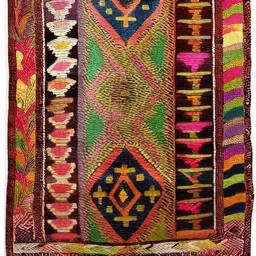
Kilims are a kind of tapestry made across North Africa, the Middle East, Turkey and the Caucasus. Kilims were often made by tribes that moved from place to place. Kilims were made to cover the floors of tents or to hold goods. In these nomadic cultures, women were usually the weavers. A mother would pass down weaving traditions to her daughter. Kilims are woven with many bright patterns and complex geometric forms. Each tribe or area has its own kilim traditions.
Another method for making floor coverings involves tying pieces of yarn onto the warp. Unlike kilims, these “pile” carpets are not flat, they are deep and soft because their surfaces are covered with the ends of thousands of pieces of yarn. These carpets are often called “Oriental” or “Persian” carpets. The National Gallery in Washington, D.C. has several fine examples of pile carpets from Iran. One red and gold carpet from the seventeenth century has complex patterns and animal designs.
There are more methods for producing artistic textiles than we have time to discuss. For example, in the United States the tradition of making quilts has a long and rich history. Quilts are made by piecing together layers of cloth to make colorful coverings. The Amish religious group is well known for their inventive and bold quilt patterns.
There also many different ways to change the appearance of the surface of a textile. Embroidery work involves using colored yarn and a needle to create designs on the surface of cloth. One famous example of embroidery work is called the Bayeux Tapestry. This eleventh century work is not actually a tapestry. It is a seventy meter long cloth covered in embroidery stitches.
The images sewn on the cloth tell about the events leading up to the Norman invasion of England in ten sixty-six. The work includes hundreds of soldiers, horses, boats, and weapons.
There are also many methods for coloring fabrics with dyes. In Indonesia, the batik method of dying fabric involves using wax to make complex patterns. In Japan, the shibori method involves tieing cloth in different ways so that some areas of it receive the dye. What kind of textile traditions exist where you live?
These textile traditions are ancient. Modern artists use these methods and others in creative and inventive ways to make new and exciting work. Artists who make art from textiles are often called fiber artists. We visited the studio of B.J. Adams in Washington, D.C. to see a fiber artist at work. https://www.youtube.com/embed/PcfQmlm12V8
B. J. Adams uses a sewing machine and thread like a painter uses color. She guides the cloth she is working on so that the machine makes stitches and slowly colors the work. This is called free-motion embroidery.
B.J. ADAMS: “I started out with drawing and painting in school. And, I always made all my own clothes. And one time, in nineteen sixty, I started to see contemporary embroidery. And I’d never seen any embroidery except what the Girl Scouts showed you. And it was so good and so interesting, I thought it was combining two things I love, art and sewing.”
Ms. Adams is always testing new ideas and methods. For example, she recently used heat transfers to copy images of paintings she made years ago onto cloth. Usually, she will cover the lines of her drawings using a straight stitch on her sewing machine. But for this series, she is experimenting with a zig-zag stitch that looks like a line made up of angles.
B.J. ADAMS: “I’m doing the whole thing in zig-zag. Just trying something new.”
Many of her works are influenced by nature, trees, and flowers. Some have a dreamy, surreal look. Others are very realistic. One work shows a large embroidered white magnolia flower sewn onto a painted surface. It is so detailed that unless you look up close, you would think it was a painting.
B.J. ADAMS: “This is one from my drawings of the magnolia, which we have in our backyard. The magnolias die so quickly when you bring them in, so I had to draw it quickly before I started in on the stitching.”
Below the flower, Ms. Adams embroidered leaves in a range of colors to show how they change as they dry.
B.J. ADAMS: “They started out this kind of dark kelly and then they go to yellow, green, and brown and end up this color down here. It’s called “Catching the Moment” because they die so quickly.”
Many works by B. J. Adams are abstract. This means there is no image, just an arrangement of forms and colors. One series is based on her time teaching in New Zealand. She used very dense stitches that are very close together to make flowing lines of bright colors.
B.J. ADAMS: “Now that one and this one are both results of bungee jumping in Queenstown. And that’s called “Bungee Attitude” and that’s called “Rebound.”
Other works are influenced by gallery shows that have a set theme.
B.J. ADAMS: “This one is “Variations on K”, because this is the word kiss in every language, including sign language. And it was made for a show that had the theme of kiss. And they required this size piece, so that was the one I created.”
Earlier, we discussed the work “Variations on H.” It hangs on a window in her colorful studio. It is made up of about forty drawings of Ms. Adams’ hands. She made each hand as an example to students while she was teaching a class on drawing using free-motion embroidery. She decided to piece together the hands into one work.
B.J. Adams sewed the drawings onto special fabric which melted away after she washed it. What is left is pure embroidery. This complex work honors the artist’s most important tool, her hands. And, it gives a good example of the endless creative possibilities of fiber art.
This program was written and produced by Dana Demange. I’m Faith Lapidus. And I’m Doug Johnson. You can see pictures of B. J. Adams’ fiber art on our Web site, voaspecialenglish.com. Join us again next week for Explorations in VOA Special English.
Related Articles

Listening to the News
60 Pages
American Culture and Customs
128 Pages
TOEIC - Level 4
85 Pages