History Stories
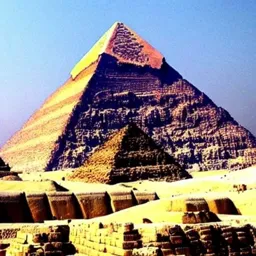
The Great Pyramid of Giza was built about 4,500 years ago as a tomb for the Pharaoh Khufu. It was originally about 146 meters high and was the tallest building made by humans for almost 4,000 years. Workers used millions of heavy limestone and granite blocks, moving them with ramps, rollers, sledges and ropes; they were skilled laborers, not slaves, and were given food and shelter. The pyramid’s sides point exactly to the four main directions, and its interior chambers were carefully planned to protect the king’s body and treasures. Today the pyramid still stands, showing the great skill and teamwork of ancient Egypt.
- tomb
- Definition: The burial chamber built for Pharaoh Khufu, serving as the purpose of the Great Pyramid.
- Example: The pyramid was created as a tomb for the Pharaoh Khufu.
- ramp
- Definition: An inclined structure that workers likely used to move and lift massive stone blocks during construction.
- Example: Most theories suggest that workers used ramps, rollers, and sledges to pull stones.
- slaves
- Definition: People mistakenly thought to have built the pyramid under forced labor, contrary to historical evidence.
- Example: Contrary to popular myths, the builders were not slaves but skilled laborers.
- cardinal
- Definition: Referring to the four main directions—north, south, east, and west—to which the pyramid’s sides are precisely aligned.
- Example: Its sides are precisely aligned with the cardinal directions—north, south, east, and west.
- ambition
- Definition: The strong desire to achieve great deeds, reflected in the pyramid as a testament to human aspiration.
- Example: The Great Pyramid represents not only a burial monument but also a testament to human ambition.
- What was the original purpose of the Great Pyramid of Giza?
- A palace for the Pharaoh
- A tomb for Pharaoh Khufu
- A temple for worship
- A storage facility for grain
- Approximately how tall was the pyramid when it was first built?
- 100 meters
- 146 meters
- 200 meters
- 250 meters
- Which materials were primarily used in constructing the pyramid?
- Brick and mud
- Limestone and granite
- Sandstone and basalt
- Wood and iron
- According to the text, how were the workers who built the pyramid compensated?
- They were paid in gold coins.
- They received food and shelter from the state.
- They were promised a share of the treasure.
- They received no compensation.
- How are the sides of the Great Pyramid oriented?
- Towards the nearest river
- Aligned with the cardinal directions
- Randomly placed
- Facing the sunrise only
- Do you think building the Great Pyramid was worth the effort? Why?
- Have you ever visited a famous historical site? Share your experience.
- What might have happened to the pyramid if the ancient Egyptians had used slave labor instead of skilled workers?
- Why do you think the pyramid’s sides are aligned with the cardinal directions?
- Some people say the pyramid was built by aliens. Do you think this idea is more interesting than the theory of human builders? Explain.
- Should modern societies invest large amounts of money to preserve ancient monuments like the Great Pyramid? Why or why not?
- Imagine you are an architect in ancient Egypt. Design a new shape for a tomb that could hold the Pharaoh’s treasures. What would it look like?
- If you could interview Pharaoh Khufu, what three questions would you ask him about the pyramid?
- How might the use of ramps versus levers have changed the time needed to build the pyramid?
- In your opinion, what is the most impressive feature of the Great Pyramid and why?

The Building of the Great Pyramid of Giza
The Great Pyramid of Giza in Egypt is one of the most extraordinary structures ever built by humans. Constructed over 4,500 years ago, it was created as a tomb for the Pharaoh Khufu, also known as Cheops. The pyramid originally stood at about 146 meters tall, making it the tallest man-made structure in the world for nearly 4,000 years. Today, it remains a symbol of the power, skill, and organization of ancient Egyptian civilization.
The pyramid was built using millions of limestone and granite blocks, each weighing several tons. Historians still debate exactly how the Egyptians moved and lifted these massive stones. Most theories suggest that workers used ramps, rollers, and sledges, pulling stones with ropes and manpower. Contrary to popular myths, the builders were not slaves but skilled laborers, farmers, and craftsmen who worked in teams and were provided with food and shelter by the state.
The design of the pyramid is a masterpiece of engineering and mathematics. Its sides are precisely aligned with the cardinal directions—north, south, east, and west. The internal structure includes passageways and chambers that were carefully planned to protect the Pharaoh’s body and treasures. Even after thousands of years, the Great Pyramid still stands as a near-perfect geometric wonder.
For centuries, the Great Pyramid has fascinated historians, scientists, and travelers. It represents not only a burial monument but also a testament to human ambition and ingenuity. When people look at it today, they see the incredible achievement of a civilization that used simple tools and human strength to create something timeless and awe-inspiring.
Related Articles

Interesting Facts
139 Pages
English Listening Rocks
62 Pages
6-Minute English
70 Pages